Nigeria @ 61

61 Birthday Nigeria

God bless Nigeria the giant of Africa
They want to be like America 🇺🇸 but suffer like Lybia
Even civilised country like SouthAfrica still respect Nigeria 🇳🇬
China 🇨🇳 kill all their early leaders and today their future is better
But can we try that in Nigeria 🇳🇬 or are we different from other African

Then we believe democracy is better
Yet some people are deprive of their rights
Bokoharam don’t want to surrender
But they want compensation from our dear leaders
Political parties fighting each other
Our governors hating one another
Students want to walk together
But the worst is our lecturers
This has given us psychological troma
As we lie low and our heart get colder

@61
Nigeria@61

Certain things make our mind shiffer
This was not the ways of our fore fathers
Neither is it the way of our own maker
Either God or Halla
But it all started from our colonial masters
Ànd now transferred to our present leaders
Who call themselves political fathers
Doing everything to take over power
By even killing their own brothers
Above all, we are Nigerians
🇳🇬@61

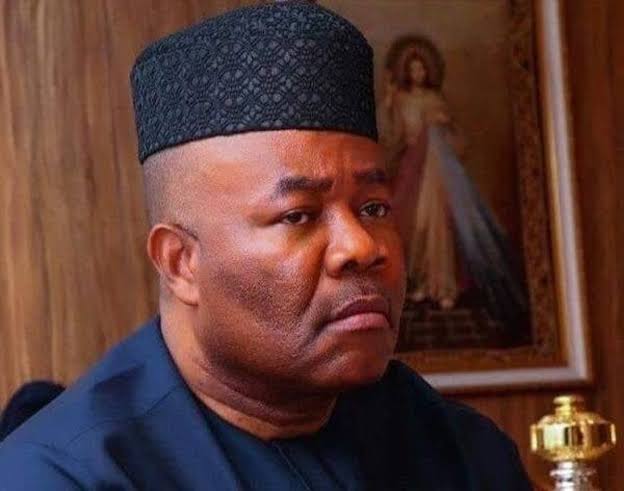
How EFCC Detained Godswill Akpabio For Two Hours After Attempting To Bribe Agency Chairman With $350,000.

According to reports, Akpabio was attempting to bribe the EFCC Chairman because he was facing several corruption charges dating back to his tenure as governor of Akwa Ibom State.

The meeting between Akpabio and Bawa was arranged by Abubakar Malami (SAN), the Attorney General of the Federation and Minister of Justice, who was recently entangled in a N5 million bribery scandal.

Before he was arrested, Akpabio was said to have personally delivered the $350,000 in cash to Bawa.

According to SaharaReporters, Akpabio and his aides were released after a phone call from the Aso Villa to the EFCC Chairman.

According to a senior EFCC source, “He and five others arrived at the EFCC office and proceeded to meet with Bawa, the newly named Chairman.

“The meeting was scheduled for the minister by the Attorney General of the Federation, who was recently appointed. You may recall his $5 million bribery case with Malami himself.

“He was ushered in at 1 p.m. to meet with the EFCC chairman while personally carrying the money. He was apprehended and detained, along with his six aides. After two hours, he was released after receiving a call from the Villa.”

However, it was unclear if the $350,000 had been issued to Akpabio at the time of writing this story, but SaharaReporters learned that Bawa had been under a lot of pressure to return the money to the minister.

According to sources, Akpabio bribed Malami and others with $5 million in order to name Effiong Akwa as the sole administrator of the Niger Delta Development Commission, which both of them denied.

There have also been reports of an N40 billion fraud in the NDDC, which is under Akpabio’s ministry’s oversight, explaining the pressure on Akpabio to clear his name of the corruption allegations that hang over his head.

Last year, the Senate and House of Representatives agreed to investigate the NDDC’s Interim Management Committee’s (IMC) suspected N40 billion financial irresponsibility in the previous three months.

However, Akpabio, whose ministry oversees the department, quickly issued a statement titled “Re: National Assembly investigates suspected N40bn corruption in NDDC,” claiming that no corruption has been detected in the NDDC while it is under the oversight of the Niger Delta Affairs ministry.

The EFCC is also investigating reports of a N86 billion contract fraud involving Akpabio and the Acting Managing Director of the Niger Delta Development Commission (NDDC), Prof. Kemebradikumo Pondei.

Another source noted the strain on Akpabio, saying, “Don’t forget that he has a long history of corruption cases with the EFCC dating back to his time as a governor. And now, with billion-dollar NDDC scams, he’s under a lot of pressure.

“When Akpabio was released, he frantically called Malami, who had arranged his meeting with the EFCC chairmen, pleading with him to drive him to the EFCC office so he could clarify to Bawa that he didn’t mean to hurt him by bribing him, but Malami said he was ill.

“Malami told him he had just returned from Turkey and had gone to Sokoto before collapsing in front of him.”

Malami collapsed in Sokoto state on April 15 while attending Governor Aminu Tambuwal’s inauguration of the restored State High Court complex, according to SaharaReporters.

The minister reportedly collapsed after giving his speech at the ceremony, but was quickly rescued by his aides and dignitaries, who assisted him in standing.

Following his return to Abuja, he was admitted to a private hospital
MEDICAL DOCTOR JAILS 14 YEARS FOR N5M FRAUD

Justice Agatha Okeke of the Federal High Court, Uyo, Akwa Ibom State, has sentenced one Dr. Bassey Goddy Usen to 14 years imprisonment without an option of fine.

Usen, a medical doctor and managing director, Ceephass Diagnostic Clinic/Surgery was prosecuted by the Uyo Zonal Office of the Economic and Financial Crimes Commission, (EFCC), on a two-count charge of obtaining by false pretence to the tune of N5 million.

One of the charges read, “That you, Bassey Goddy Usen, the Managing Director of Ceephass Diagnostic Clinic/Surgery on or about the 18th April, 2017 in Uyo, within the jurisdiction of this honourable court with intent to defraud, obtained the sum of N2,000,000.00 (Two million naira) from one Edodiong Essien under the pretence that the money will be used to execute contracts awarded to you by Akwa Ibom State Hospital Management Board, Uyo; a pretence you knew to be false and thereby committed an offence contrary to Section 1 (1) (a) of the Advance Fee Fraud and Other Fraud Related Offences Act 2006 and punishable under Section 1 (3) of the same Act”. His “not guilty,” plea set the stage for his trial which commenced on October 24, 2018.

In the cause of the trial, prosecution counsel, Agbo S. Abuh presented four witnesses and tendered various exhibits which were admitted in evidence, and closed its case on February 28.

Delivering judgement on Monday, Justice Okeke noted that the prosecution proved its case beyond reasonable doubt and sentenced the defendant to seven years imprisonment on each of the two-count charges. Though there was no option of fine, the prison terms will run concurrently with effect from the day of his arrest. In addition, the convict would restitute the sum of N3 million to his victim as a condition for his release upon completion of his jail term.

Usen’s journey to prison began in 2018, when his victim, Edodiong Essien petitioned the EFCC, alleging that the convict approached him for a loan to enable him to execute a contract, purportedly awarded to him by Akwa Ibom State Hospitals Management Board for the supply of drugs to rural hospitals in the state.

While his claim for the loan is false, as the convict’s name did not feature as a contractor with the state’s Hospital Management Board, he flouted the terms of repayment, and furthermore, issued his victim with dud cheques.

THE MISSING LINK IN ECONOMICS DEVELOPMENT IN NIGERIA.

Nigeria has been pursuing techno-economic development objective since the 1962/65 development plan with very limited success. This suggests that Nigeria’s development strategy may have ignored the progenitor of modern industrial evolution. Interestingly, insights from the early canons of economic thought unequivocally demonstrated that the capital goods sector is the most strategic factor behind industrialization in general and techno-economic development in particular. But unfortunately, contemporary development literature and policy is mute on the subject. It is argued that the absence of a dynamic local capital goods sector is the key reason behind Nigeria’s import and technological dependence, high rate of unemployment and underdevelopment broadly construed. The critical importance of the capital goods sector for industrialization and techno-economic development stems from the fact that it is the hub for technological innovation, technological entrepreneurship and technological learning-by-doing. Thus, the capital goods sector gives the economy the capacity to become innovative, to become reproductive in character, to create wealth at will, to generate employment and to effectively tackle the challenges of underdevelopment. The applicability of the capital good-led growth strategy is nevertheless contingent on three preconditions (availability of investment capital, availability of absorptive capacity and willingness to invest in capital goods) which Nigeria and other large developing countries can satisfy. Conventionally and theoretically increase in money supply according to the quantity theory of money triggers a high inflation rate in developed and emerging economies. The reality in Nigeria contravenes the quantity theory of money. This study investigates the missing link in Nigeria from January 2010 to December 2018 by applying the Johansen co-integration, Granger causality tests and Vector Error Correction Model (VECM) on the monthly data. The findings indicated that money supply does not cause inflation. Inflation is caused by non-monetary factors of political instability, corruption, poor basic infrastructure among others. Money supply and inflation co-integrate in the long-term. The causality test proposed a uni-directional flow from inflation to the money supply. Bi-directional causality was not observed in this study. The VECM resulT indicated that disequilibrium caused in the previous year can converge back to equilibrium in the current year. The general findings of the study disagreed with the quantity theory of money. The study recommends that non-monetary factors of political instability, corruption, poor basic infrastructure among others were responsible for the missing link. These factors should be checked and put in perspective to achieve lowinflation at a single digit in Nigeria.

METHODOLOGY

This study used monthly time series data from the Central Bank of Nigeria‘s (CBN) Statistical Bulletin from January 2010 to December 2018 to explore the long and short-term relationship and causal link between money supply and inflation in Nigeria.

  1. Implicit Price Deflator to GDP: measured inflation rate and is calculated as the GDP at the current basi prices divided by the GDP at the constant basic prices. The ratio explains and accounts for the change effects of inflation on the overall prices of products and services that make up the GDP.
  2. Money Supply: M2 and M3 were used to investigate the dynamics of inflation. M3 included, M2, M1, M0 and liquid components of money supply that were not in circulation such as repurchase agreement and was the broadest measure of money supply in an economy. M2 consisted of all of M0 and M1 in addition to saving deposits and certificates of deposit.
  3. Monetary Policy Rate (MPR): The minimum rediscounted rate (MRR) served as the CBN interest rate benchmark which anchors all other interest rates in the money market and the economy, influencing the cost of funds and its direction in the economy. Gross Domestic Product: measures the rate of economic growth.

THESE THE FACTORS HINDERING NIGERIA TECHNOLOGY

  • The Government does not value technology as much as they should. …
  • Nigerians do not understand or trust technology. …
  • The cost of running a technology company is too high. …
  • It exposes corruption. …
  • Nigerians do not trust things made in Nigeria.
Design a site like this with WordPress.com
Get started